“To Zowa Sho” means “Come eat!” in Dzongkha the official language of Bhutan. This simple invitation encapsulates what this blog hopes to do because it implies that you are not eating alone, that eating is an inherently communal act.
Showing posts with label chilli. Show all posts
Wednesday, May 25, 2016
Chilli seedlings : a time to plant
After repeated reminders ( nagging!) from our housekeeper I finally bought some chilli seedlings for our garden. We have had a wet cold spring and have neglected our garden. Here is hoping that this purchase is the beginning of change. I am admittedly neither a knowledgeable or consistent gardener but now that my parents have moved back to rural Bhutan we are being expected to take a more active role. Finger crossed?
Sunday, April 3, 2016
Bitter Flowers
My sister recently traveled to the south of Bhutan for work and came back with low-land treats including lots of bananas and some of the flowers you see on the left. Yes, the flowers are to eat! In Dzongkha we call them bashika. I am not sure of what they would be called in English but the scientific name for the shrub that these flowers grow on is Adhatoda vasica. The flowers are collected from the wild and was were fact among the many plants documented in a survey of wild and edible plants in Bhutan. Bhutanese believe that the bitter flowers have medicinal properties.
The same plant is in fact part of the range of plants used in traditional Indian medicine but instead of the flowers they use the leaves which are either brewed into a tea or ground into a paste.
According to the survey of wild and edible plants there are several ways in which the flowers can be prepared including with meat, stir-fried or made into a datshi with chili and cheese. Our house-keeper, Yeshi made a datshi out of the flowers for lunch yesterday.
She began by boiling the flowers on our gas stove, she explained that this would clean the flowers as well as remove some of the bitterness. Below is the pot of flowers after they were boiled. Yeshi points out how brown the water has become.
Next the flowers were drained and placed in a bowl with fresh water. Yeshi then scooped out the flowers and pressed out the water by hand.

This is what the boiled, drained and hand strained flowers looked like.
Then Yeshi had to painstakingly clean the flowers by hand, removing any remaining dirt as well as a large green, very boiled caterpillar. ( Poor guy!)
Afterwards she added the typical ingredients for a datshi. Chili, salt , a little bit of vegetable oil and water. The cheese is added after the dish is almost cooked. In this case we were out of Bhutanese cheese, so Yeshi used the processed Indian cheese that is becoming the standard in many Bhutanese kitchens.
And here we have the finished product, ready to eat.The texture of the flowers was a little slimy but not unpleasant and the taste was less bitter than I remember. Its possible that they were boiled a little too zealously removing too much bitterness.
For more on survey of wild and edible Bhutanese plants:
Kinlay Tshering ( 2012 “ Edible and Wild Plants of Bhutan and their contribution to food and nutritionsecurity” Horticulture Division, Department of
Agriculture Ministry of Agriculture & Forests, Royal Government of Bhutan
Saturday, January 31, 2015
Tshomin's Tree Tomato Ezay
This time of year, when tree tomatoes are in season, Tshomin often whips up a batch of her famous Ezay, a sort of side dish/ condiment to add a little spice to any rice-based meal. Above is a handful of the fresh tree tomatoes, you can see that tree tomatoes are little more egg shaped than "regular tomatoes." This ezay is the only recipe I know for the tree tomato though once at the lovely Zhiwa Ling hotel in Paro, I ate them poached in honey as dessert. Very tasty!
Then both the tomatoes and the red chilli have to be roasted. In our house this is done over an open flame . Tshomin braves burnt fingers as she carefully turns the chili and tomato until they are both nicely roasted as indicated by the blackening skin seen in the picture below.
The roasted tomato must then be peeled. The skin is tough but the flesh is wonderfully pulpy once its been roasted. Again this takes quick fingers, unafraid of a little heat. I love the tufts of steam you can see rising as Tshomin peels
Next both the peeled tomato and the roasted chili are roughly chopped. If you wanted to take the heat down a little you can take the seeds out of the chili but we are not that kind of family. Again look at that steam!
Now its time to use the pestle to crush and grind the ingredients down into a thick, chunky paste. Just before the ezay is done Tshomin adds salt, crushed Sichuan peppers and fresh chopped coriander.
The end produce looks like this. Thought admittedly at many meals we serve it straight for the mortar!
As you can tell this particular batch of ezay was not made for a typical Bhutanese meal but it was just as appreciated with oven roasted chicken and peas as it might have been with a more traditional spread.
Labels:
chilli,
family,
recipes,
Tshomin,
what we are eating
Saturday, July 27, 2013
Dried Chilies ( Long overdue post #2)
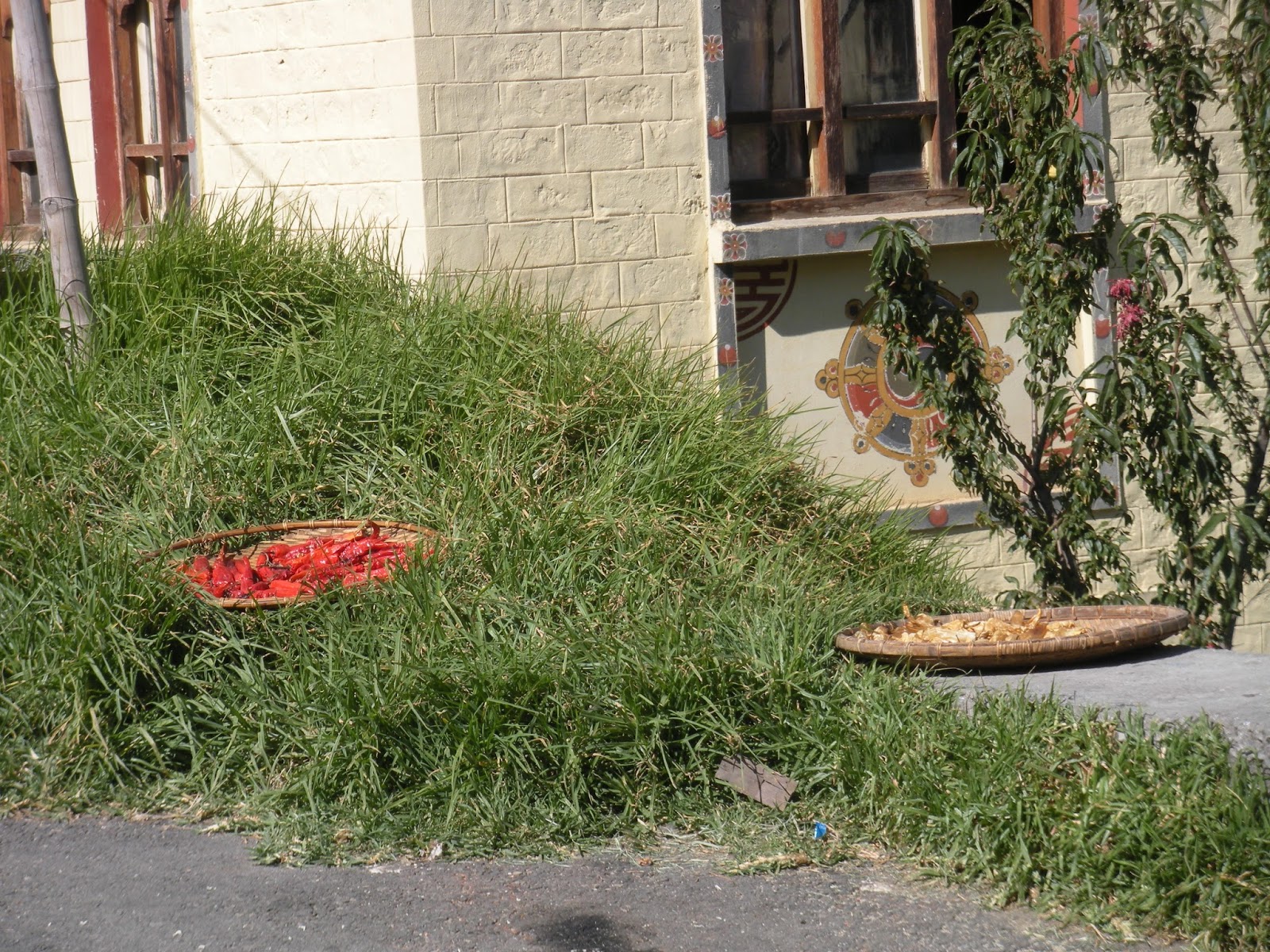
Unsurprisingly chili is one of the most commonly dried "vegetables" in Bhutan. In the past when transporting vegetables was difficult this was an important way of insuring a year long supply. Times have changed and fresh chilies are available year long but Bhutanese still choose to dry some of their supply.
According to Kunzang Choden in her book " Chilli and Cheese: Foods and Society in Bhutan" sun drying is still the most common way to dry chilies. She also make the following observations about the colors of dried chilies :
"Mature chilies, which begin to get a tinge of red coloration, easily turn read when sun dried. Green chilies split in half and sun dried retain their color so they are green even when dried. The biggest chilies are selected and blanched by immersing them for some minuets in a pot of boiling water and then drying them in the sun. These chilies become a yellowish creamy color when dried and are known as shur kam ( boiled and dried or white chilies). The colored chilies preserved in different ways not only add color to the dishes but also widen the possibilities of different tastes and textures."
Below are some picture I took in the fall and winter of chilies being dried in my own neighborhood.
Saturday, February 9, 2013
Reading Notes: Dried Chili
Taken from the blog "Imperfectly Perfect- Simply Being by Me" by Thimphu based blogger, Chuki. Here she writes about dried chili both as a harbinger of Bhutanese winter and as something she loves to eat.
Note: Shakam-- is the Dzongkha word for dried meat. Any dried food has the suffix "kam" added to it.
"Perhaps the best part about winter is the dried red chili. I know the cold season is just round the corner when I drive past houses and see windows and verandas decorated with strings of red chili. I can see the winter sun working on them diligently.
Like any normal Bhutanese, I love chili for reasons I hardly care to find out. And the dried ones are even better. It effortlessly blends with every other item. Shakam with red chili, vegetables with red chili, or red chili with cheese!"
Note: Shakam-- is the Dzongkha word for dried meat. Any dried food has the suffix "kam" added to it.
Tuesday, October 2, 2012
Reading Notes: Sensitive chilli plants
From " Chilli and Cheese: Food and Society in Bhutan" by Kunzang Choden
"Our understanding of the sensitivity of plants and our environment was once profound: I recall how forty years ago people from Bumthang who had gone gleaning to Lhuentse District were not allowed to go into gardens because the unfamiliar presence of new people with alien smells of chemicals like soap and face creams had an adverse effect on chilli plants."
Subscribe to:
Posts (Atom)