Showing posts with label food preservation. Show all posts

Saturday, July 27, 2013

Dried Chilies ( Long overdue post #2)

Bhutanese famously think of chilies as a vegetable and not a spice, every meal requires them.  Unsurprisingly chilies are grown in every single district or dzongkhag in Bhutan, thought of course as this article put out by the agriculture ministry points out, climate and elevation differences mean that there is necessarily a lot of variety in the types of chilies grown. Chilies are grown both for personal family consumption and to sell in the local market. 


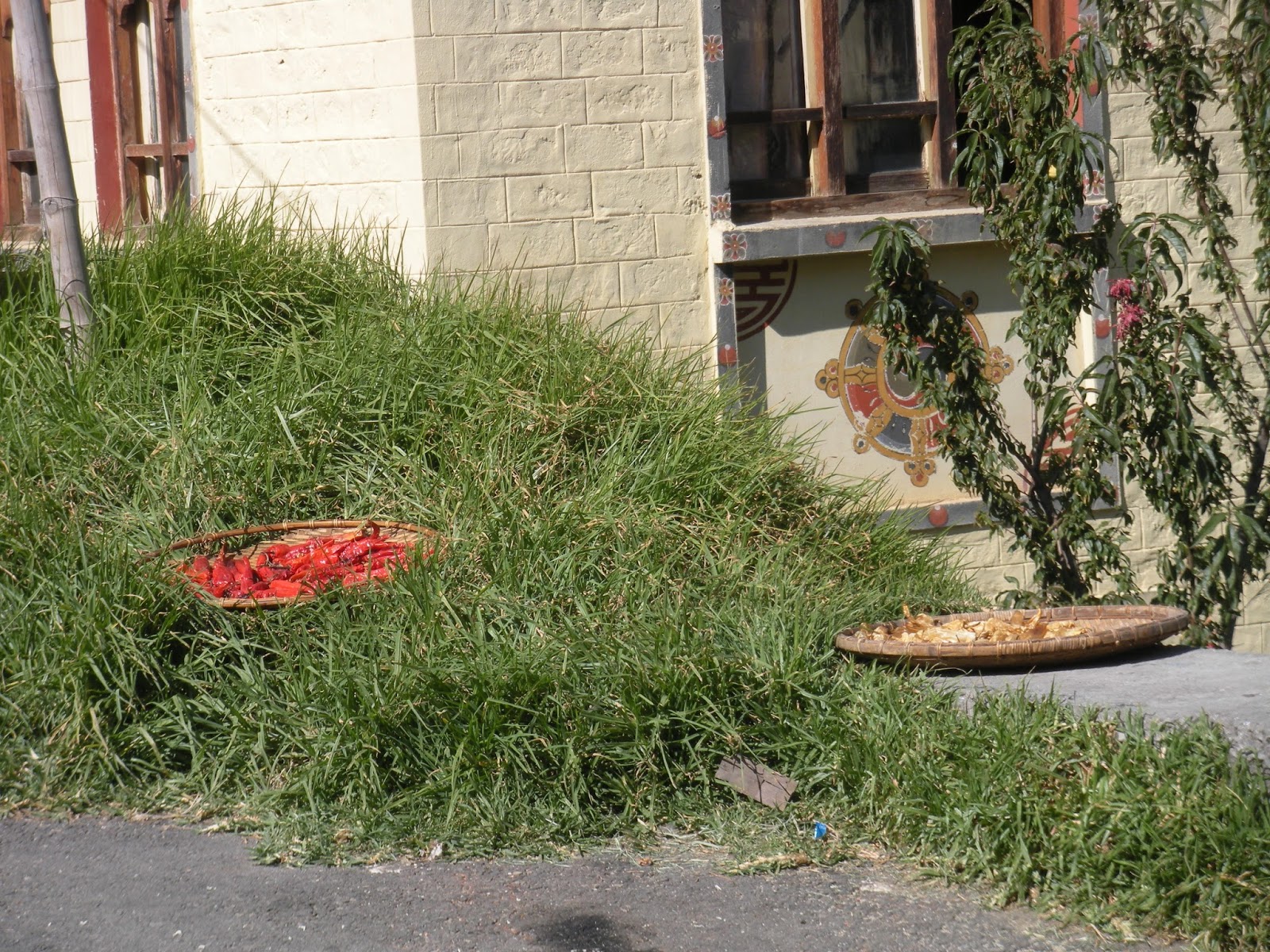
Unsurprisingly chili is one of the most commonly dried "vegetables" in Bhutan. In the past when transporting vegetables was difficult this was an important way of insuring a year long supply. Times have changed and fresh chilies are available year long but Bhutanese still choose to dry some of their supply.

According to Kunzang Choden in her  book " Chilli and Cheese: Foods and Society in Bhutan" sun drying is still the most common way to dry chilies. She also make the following observations about the colors of dried chilies  :
"Mature chilies, which begin to get a tinge of red coloration, easily turn read when sun dried. Green chilies split in half and sun dried retain their color so they are green even when dried. The biggest chilies are selected and blanched by immersing them  for some minuets in a pot of boiling water and then drying them in the sun. These chilies become a yellowish creamy color when dried and are known as shur kam ( boiled and dried or white chilies).   The colored chilies preserved in different ways not only add color to the dishes but also widen the possibilities of different tastes and textures." 

Below are some picture I took in the fall and winter of chilies being dried in my own neighborhood.




Saturday, July 20, 2013

Dried Meat ( long over due post #1)

It's July, summer holidays and at long last I have time to catch up on some of the posts that I had planned to do ages ago. This post on dried meat has been waiting since the winter!


Thimphu winters are typically dry and cold. There might be some early morning frost, even the occasional snow but in general winter is a very dry time.  Many Thimphu residents take full advantage of this dryness.  Strings of meat and chili hung out on washing lines, on balconies and out of windows are a familiar sight all over the city during this time of year. 


I love that in an age where most urban middle class families have fridges  and there is a reliable weekly market with fresh vegetables that people still spend time and energy preparing vegetables and meat to dry. 


Our family bought a leg of beef to dry this winter. The meat has to be cut into long narrow stripes and then hung out to dry. Its actually easier to do this messy work outdoors. Below is a family friend who  helped us cut our meat up this year. You can see that we just lay out a plastic sheet and did the chopping mostly  without a cutting board 


We did have some very interested observers. Here is our ( greedy) family dog, eagerly and carefully watching the work being done. Don't worry he got his share of the bones!


And here is the final product hung out to dry. The meat takes several days to dry so at night we have to cover it all and guard it from birds, dogs and cats. Sadly this year we had actual human thieves come and steal a portion of our meat overnight and then our clever cat got into our storage and ate the rest of it.


So how do we eat the dry meat? It came be cut up and eaten as is, often with a chili paste. Growing up my all time favorite breakfast was " Bhutanese breakfast" -- Suja ( butter tea), rice, ezay ( chili paste) and shakam ( dried meat) that had been lightly roasted usually over an open flame.  More often however  we cook it with vegetables ( like dried turnip leaves ) and chili as show in the picture below. 


Saturday, February 16, 2013

Reading notes: Food Processing and the Growth of Cities

Rachel Lauden a historian who has a wonderful blog about the history and politics of food, recently had a great post  ( with wonderful vintage photographs of cod and pasta drying, well worth a look) wondering aloud about the amount of space that traditional food processing takes and how this may have impacted the growth of cities.

"I’m toying with the idea that one factor contributing to the growth of cities was the development of space-saving methods of processing foods, such as commercial drying facilities for pasta.
In early days (ancient Rome, for example) this commercial milling and baking would have dramatically reduced the space needed to produce daily bread. In the Industrial Revolution, steel roller mills, huge bakeries, vacuum pans for evaporating liquids, and so on would similarly have made operations more compact."

Saturday, February 9, 2013

Reading Notes: Dried Chili

Taken from the blog "Imperfectly Perfect- Simply Being by Me" by Thimphu based blogger, Chuki.  Here she writes about dried chili both as a harbinger of Bhutanese winter and as something she loves to eat. 

"Perhaps the best part about winter is the dried red chili. I know the cold season is just round the corner when I drive past houses and see windows and verandas decorated with strings of red chili. I can see the winter sun working on them diligently.
Like any normal Bhutanese, I love chili for reasons I hardly care to find out. And the dried ones are even better. It effortlessly blends with every other item. Shakam with red chili, vegetables with red chili, or red chili with cheese!"

 Note: Shakam-- is the Dzongkha word for dried meat. Any dried food has the suffix "kam" added to it.

Friday, February 8, 2013

Dried things: An Introduction


This is a picture of a recent home cooked dinner, one my all time favorite Bhutanese meals. It might be a little hard to tell what it is from the picture but the dish consists mainly of three different dried ingredients: dried meat, dried turnip leaves and dried red chilies.

This time of year, winter time, the weather is dry and sunny and everywhere you go, even in dense urban Thimphu,  people are drying food in whatever space they have available. Sometimes they have strings of red chili drying out of a window, strips of meat on a clothes line or a layer of chili laid out on a rooftop.  Once again I love that despite all the change in our eating habits (for example, my mother complained again yesterday about the over-use of processed Indian cheese in Bhutanese dishes) and fridges and weekly vegetable markets and meat shops,  there is still so much fondness for an old-fashion food preservation process like drying.

According to Dr Brian Nummer of the National Center for Home Food Preservation ( proof that there is a national center somewhere for everything!) drying as a food preservation technique is not only found not in every culture in world but also throughout human history. Its one of the oldest, most prevalent ways to deal with the fact that fresh food doesn't stay fresh all that long.

Over the next few posts I am going to share a little bit about how my family and other families in Bhutan dry foods and also how they cook and eat them. Join me?