My job keeps me tied down to Thimphu for large chunks of the year ( thought admittedly for now I get a lovely long winter break) so I am always grateful to be able to read about other people's travels. All year I have followed this blog by an Australian teacher living in Bumthang with her family. She recently wrote about traveling eastward to attend the Matsutake Mushroom Festival in Ura. Bhutanese collect Matsutake or Sangay Shamu ( Buddha Mushroom) to sell on the lucrative Japanese market where this particular mushroom apparently heralds seasonal change. Her post on the festival is delightfully rambling ( its a little like listening to a work friend talk about their weekend over Monday morning coffee) so not all of the post is focused on mushrooms but its worth a look for the absolutely wonderful photos of the festival in general and the mushrooms in particular.
Monday, September 23, 2013

Sunday, September 22, 2013
Low tech apple harvesting
It apple season in our garden and unfortunately the birds are getting to the applies faster then us. Below is a sample of the damage.

My father ( a bit of a bird watcher) has been known to comment that he wouldn't mind sharing the apples if the birds actually finished an apple instead of leaving half of them uneaten!
Sadly we have no tree climbers living in the house at the moment so apple harvesting has not been as smooth a process. This year we low-tech-ing it.
Allow me to demonstrate:
Brother on a ladder using a long stick to shake the branches .....

...plus sister and father below holding a sheet to catch falling apples ....

.....equal limited success. Far too many apples miss the sheet and land up bruised and smashed

Still to have a couple of these tasty beauties ... it's worth it!

Saturday, September 21, 2013
Happy Blessed Rainy Day

Today is Blessed Rainy Day in Bhutan or Thure, a nationally observed holiday that marks the end of the monsoon (or rainy season) and the beginning of the fall. For farmer ( which according to most statistic would describe most Bhutanese) it means the growing season is behind them and the harvest is not very far away.
On Thure all natural water is considered holy and everyone is encouraged to take an outdoor bath in order to cleanse themselves of their accumulated bad karma. Some people will leave a bucket out to gather rain overnight and then bathe with it in the morning.
Its also an important family holiday and when I taught in the east of Bhutan, where the holiday is considered particularly important, many of my students made a huge effort to travel home for the day. As it is with many family holidays sharing a meal is an important part of the celebration. Many families will start the day with a bowl or two or three of rice porridge or Thup is particularly important
My sister's inlaws ( who are easterns) invited us to join them for breakfast which of course turned into a regular feast.
As with many visits in Bhutan the meal started off with sweet milk tea and biscuits ....


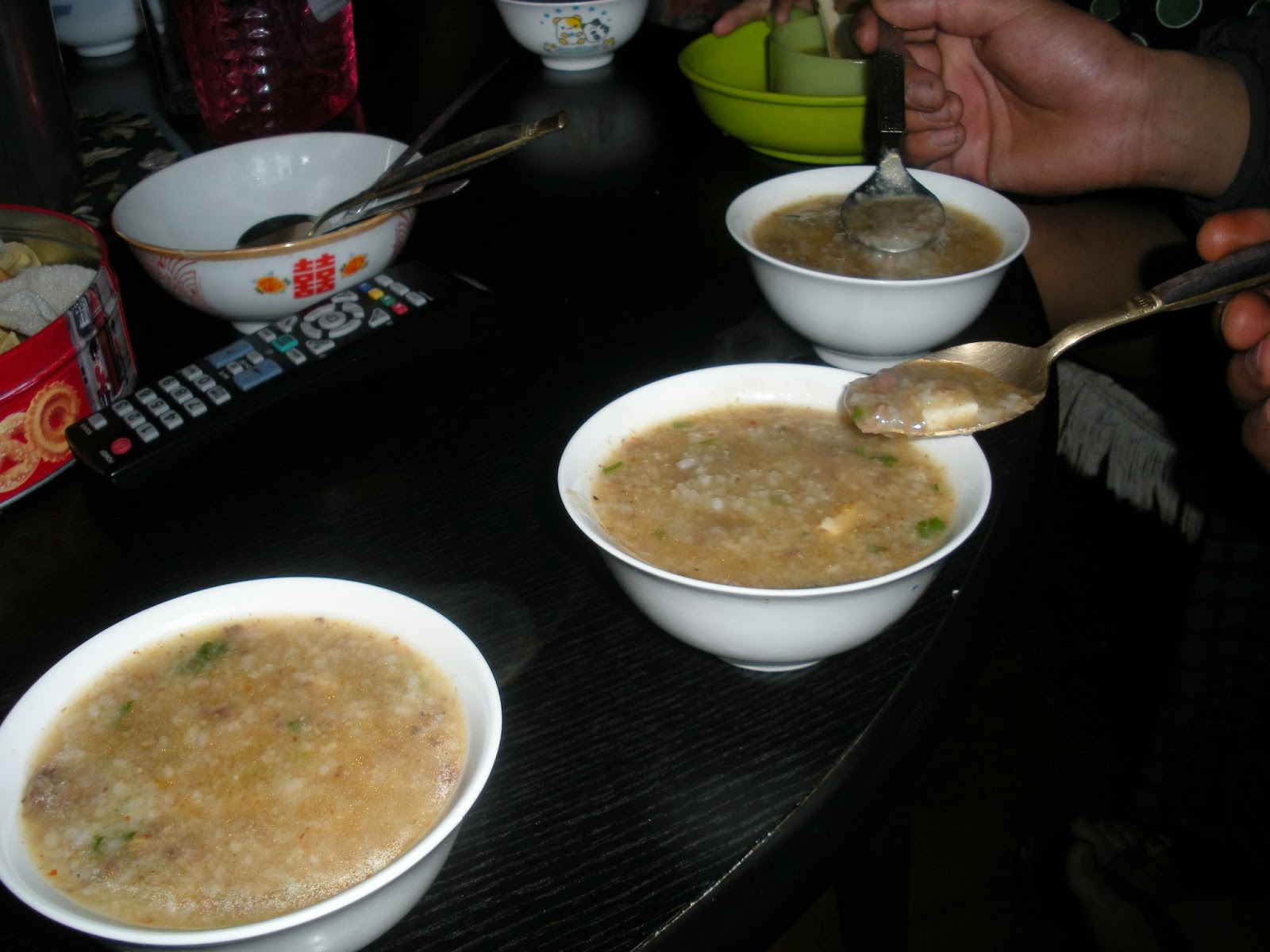
I ate three bowl full of the rice porridge before realizing that another rice dish, shamdey ( a mixture of rice, butter, meat, eggs and sometimes a little spring onion) was waiting to be served!


This time with a little suja or butter tea....

At the end of the meal my sister's father-in-law insisted that my brother, Sonny, join him in celebrating the day with a glass or ara or home brewed alcohol.

Another reason to raise a glass? This post mark an anniversary for this blog! One year ago one of my very first posts was about Blessed Rain Day and the thub we ate!
Friday, September 13, 2013
Reading Notes: Asian Beers
A former intern recently wrote to "blame" me for her fondness for South-east Asia. I encouraged her to apply for a scholarship to spend a summer in Laos and she has wanted to return to that part of the world ever since. She recently took up a teaching position in Vietnam and has been blogging about her adventure there including this recent post about all the different Asian beers she has tried since she arrived. As a firm believer that context and atmosphere plays a huge part in how we enjoy food and drink her final piece of advice is spot on, she writes " If you decide to try one of these beers back in the states and think its horrible, don't blame me. Book a flight to Southeast Asia and grab a Beerlao in Laos, I promise it will taste a whole lot better."
As well as inspiring a little jealousy and wanderlust, the post definitely also encourages me to consider writing about Bhutanese beers in the near future!
Friday, August 30, 2013
Reading notes: NPR 's dumpling week
All week the NPR food blog, The Salt, has been sending out great dumpling stories, many of which include fabulous recipes that I don't have the time to try. Perhaps the most interesting post was one in which they attempted to document all the many, many, many kinds of dumplings, what they are calling their "Global Dumpling List." And yes, momos are on the list but more interesting is their list of " disputable dumplings" that includes everything from empanadas to samosas. Why disputable? Because NPR put together a panel of "Dumpling Experts" to help them decided what should actually be considered a dumpling!
Friday, August 23, 2013
Reading Notes: Instant Noodles
Summer holidays are behind me and I am back at work which means , once again, less time for original blog content. As if NPR food blog, The Salt, knew that I didn't have time to come up with my own content, earlier this week they put out a great post on the global popularity of instant noodles. Elsewhere on this blog I mentioned how my time at boarding school gave me a real fondness for instant noodles so it always gives me a twang of sadness when someone is dismissive or worse, hyper critical of instant noodles. In boarding school we ate instant noodles because we thought the school food was "gross," because they were easy to make ( we could even eat them raw, sometimes mixed into a bag of chips), because we could get them cheap and because it was easy to add things to them like chili powder, dried mushrooms, vegetable and cheese to customize and improve the taste. The NPR article points out that these are many of the same reasons that instant noodles are popular all over the world:
it's the multinational noodle companies' conquest of countries like Papua New Guinea, Nigeria, Brazil and Mexico that really interests the anthropologists: Frederick Errington of Trinity College, Tatsuro Fujikura of Kyoto University and Deborah Gewertz of Amherst College. And it's here that they make one of their most intriguing arguments: Instant noodles do good by alleviating the hunger of millions of people around the world. These supercheap, superpalatable noodles, they write, help the low-wage workers in rich and poor countries alike hang on when the going gets tough."They're cheap and tasty and tweakable," Gewertz tells The Salt. "They're capable of being transformed to everyone's cultural taste."In Thailand, instant ramen is seasoned with lemongrass and cilantro. Mexicans can buy Maruchan noodle soup cups flecked with shrimp, lime and habarnero , among other flavors. Papua New Guineans have incorporated the noodles into rituals as cardinal as weaning babies and honoring the dead, she says.
Saturday, July 27, 2013
Dried Chilies ( Long overdue post #2)
 Bhutanese famously think of chilies as a vegetable and not a spice, every meal requires them. Unsurprisingly chilies are grown in every single district or dzongkhag in Bhutan, thought of course as this article put out by the agriculture ministry points out, climate and elevation differences mean that there is necessarily a lot of variety in the types of chilies grown. Chilies are grown both for personal family consumption and to sell in the local market.
 Unsurprisingly chili is one of the most commonly dried "vegetables" in Bhutan. In the past when transporting vegetables was difficult this was an important way of insuring a year long supply. Times have changed and fresh chilies are available year long but Bhutanese still choose to dry some of their supply.
According to Kunzang Choden in her book " Chilli and Cheese: Foods and Society in Bhutan" sun drying is still the most common way to dry chilies. She also make the following observations about the colors of dried chilies :
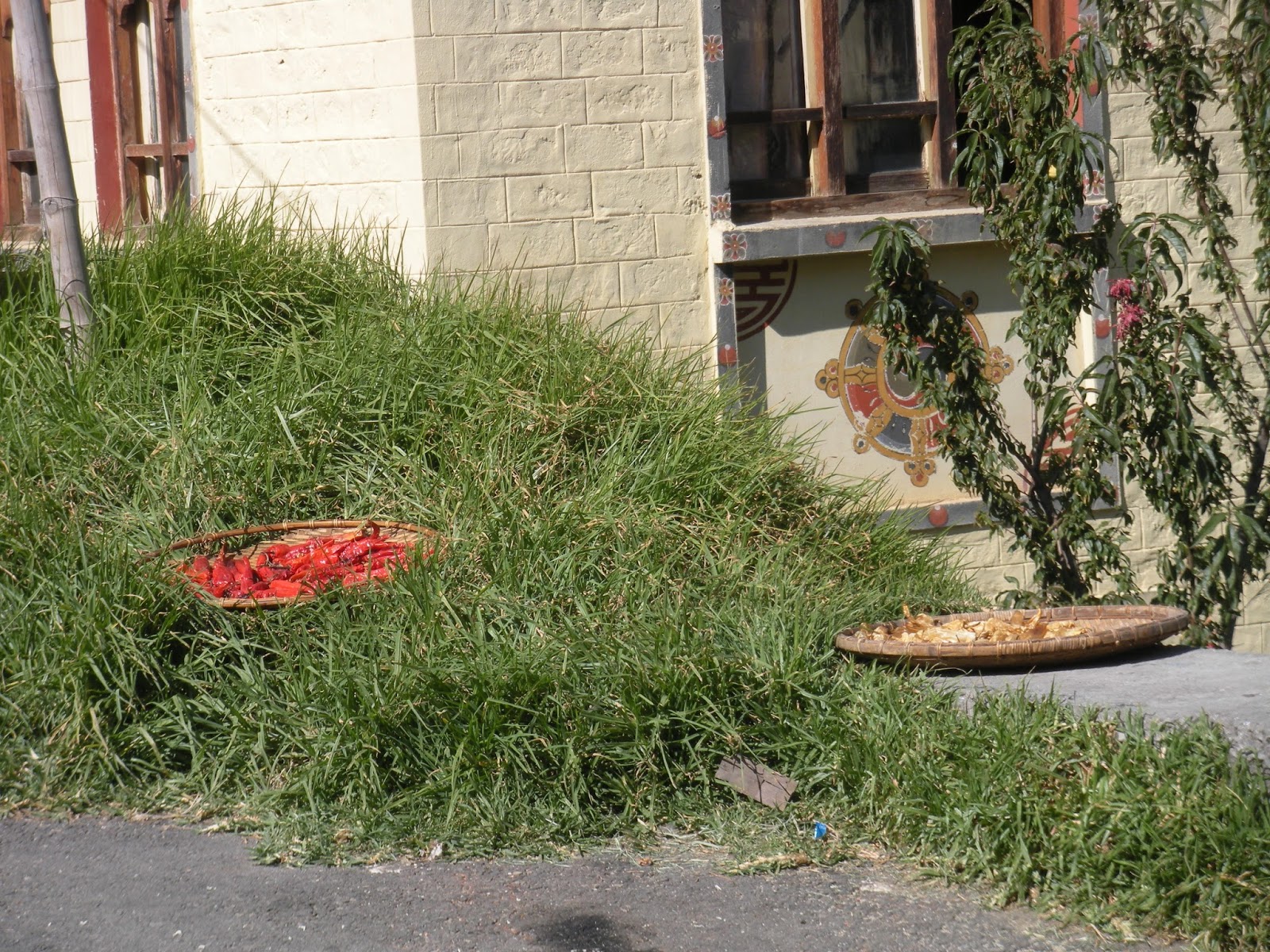
"Mature chilies, which begin to get a tinge of red coloration, easily turn read when sun dried. Green chilies split in half and sun dried retain their color so they are green even when dried. The biggest chilies are selected and blanched by immersing them for some minuets in a pot of boiling water and then drying them in the sun. These chilies become a yellowish creamy color when dried and are known as shur kam ( boiled and dried or white chilies). The colored chilies preserved in different ways not only add color to the dishes but also widen the possibilities of different tastes and textures."
Below are some picture I took in the fall and winter of chilies being dried in my own neighborhood.




Subscribe to:
Posts (Atom)