“To Zowa Sho” means “Come eat!” in Dzongkha the official language of Bhutan. This simple invitation encapsulates what this blog hopes to do because it implies that you are not eating alone, that eating is an inherently communal act.
Wednesday, May 25, 2016
Chilli seedlings : a time to plant
After repeated reminders ( nagging!) from our housekeeper I finally bought some chilli seedlings for our garden. We have had a wet cold spring and have neglected our garden. Here is hoping that this purchase is the beginning of change. I am admittedly neither a knowledgeable or consistent gardener but now that my parents have moved back to rural Bhutan we are being expected to take a more active role. Finger crossed?
Sunday, April 24, 2016
Reading Notes:How "typical" is Kewa Datsi?
Frequently when Bhutanese live outside Bhutan are asked to cook a "typical" Bhutanese meal they will whip up Kewa Datsi- a stew-like dish with potatoes, chilli and cheese. However research on history of potato in Bhutan suggests that potato might be a fairly new "typical" Bhutanese food. The below extract comes from the " The Potato in Bhutan" ( 2008) by Walter Roder, Karma Nidup and Ganesh B. Chettri.
"Potato consumption in Bhutan was low up to the 1970s. In the early 70s, when farmers started growing potato for export, they were generally reluctant to consume the tuber. Eating potato as a staple was socially and culturally unacceptable as many Bhutanese believed that potatoes caused problems of the lower abdomen, vomiting, constipation and diarrhea. Similarly, in the 19th century ethnographical descriptions of Tibet, potato consumption was said to be " confined to the poorer classes" ( Rockhill 1891). Over the last four decades, the status of potato as a food or vegetable has changed tremendously. Today unlike in the 70s , potato is widely eaten as a vegetable and sometimes even as a staple food."
Saturday, April 9, 2016
Reading Notes: Bhutanese Eating Etiquette
From: Tshering C Dorji and Rinchen Dorji (2005) "Living the Bhutanese Way" DSB Publications, Thimphu
Under the Driglam Choesum or Za Cha Do(e) Sum, a code of standard practices was framed, based on three kinds of human activity: eating, doing things and walking. It is said that no matter how rich a person is, he should never eat sleeping and no matter how poor a person is, he should not eat standing. Therefore, a person eats sitting properly.
A person can only eat that amount of food which can be held within two fingers and a thumb of the right hand. He is expected to keep the drinks on the left side and the solid things to the right. A person should not pile bones in front or behind. The person keeps them inside his hemcho ( the pouch). Jokes are told about a person who carried all the bones in his pouch and ate peacefully outside without having to fear an imposition of any discipline.
A person is expected to eat his food with closed mouth and not make much noise while eating. He is expected not to talk which he has food in his mouth.
Bhutanese in the villages usually crush the cereal into small balls and eat. The more compact the cereal ball, the more filling of the stomach, so they don't get hungry soon. Stories are being said that in the olden days the people judged a person whether he could work or not from the amount of breakfast he ate. If the person ate a smaller amount of breakfast, the person was regarded as a weakling.
Sunday, April 3, 2016
Bitter Flowers
My sister recently traveled to the south of Bhutan for work and came back with low-land treats including lots of bananas and some of the flowers you see on the left. Yes, the flowers are to eat! In Dzongkha we call them bashika. I am not sure of what they would be called in English but the scientific name for the shrub that these flowers grow on is Adhatoda vasica. The flowers are collected from the wild and was were fact among the many plants documented in a survey of wild and edible plants in Bhutan. Bhutanese believe that the bitter flowers have medicinal properties.
The same plant is in fact part of the range of plants used in traditional Indian medicine but instead of the flowers they use the leaves which are either brewed into a tea or ground into a paste.
According to the survey of wild and edible plants there are several ways in which the flowers can be prepared including with meat, stir-fried or made into a datshi with chili and cheese. Our house-keeper, Yeshi made a datshi out of the flowers for lunch yesterday.
She began by boiling the flowers on our gas stove, she explained that this would clean the flowers as well as remove some of the bitterness. Below is the pot of flowers after they were boiled. Yeshi points out how brown the water has become.
Next the flowers were drained and placed in a bowl with fresh water. Yeshi then scooped out the flowers and pressed out the water by hand.

This is what the boiled, drained and hand strained flowers looked like.
Then Yeshi had to painstakingly clean the flowers by hand, removing any remaining dirt as well as a large green, very boiled caterpillar. ( Poor guy!)
Afterwards she added the typical ingredients for a datshi. Chili, salt , a little bit of vegetable oil and water. The cheese is added after the dish is almost cooked. In this case we were out of Bhutanese cheese, so Yeshi used the processed Indian cheese that is becoming the standard in many Bhutanese kitchens.
And here we have the finished product, ready to eat.The texture of the flowers was a little slimy but not unpleasant and the taste was less bitter than I remember. Its possible that they were boiled a little too zealously removing too much bitterness.
For more on survey of wild and edible Bhutanese plants:
Kinlay Tshering ( 2012 “ Edible and Wild Plants of Bhutan and their contribution to food and nutritionsecurity” Horticulture Division, Department of
Agriculture Ministry of Agriculture & Forests, Royal Government of Bhutan
Saturday, March 26, 2016
Reading Notes: Fishing in Haa
From: " Memoirs of a Political Officer's Wife in Tibet, Sikkim and Bhutan" by Margaret D. Williamson, an account of her life and travels in the Himalayas during the early 1930's.
" Our final day in Ha, we watched an unusual way of fishing. One line of boys, beating the water with sticks, drove the fish downstream to where another line of boys were waiting in a 'V' formation. The latter than funnelled the fish into the wide mouth of a tapering bamboo basket"
Saturday, March 19, 2016
The return of "To Zowa Sho"
I recently caught up with an old friend from high school who wants to take up blogging about local food traditions in her home country, Nepal. Since she was always the best cook in our dorm I can't believe she didn't come to this idea sooner. She can't believe I stopped updating this blog. "You are in the perfect place to do this kind of writing," she reminded me. As always her enthusiasm was infectious. Its been more than a year since my last post but after that conversation I am finally ready to come back to regularly blogging about Bhutanese food.
To celebrate my return, here is my favorite food photo of the last year. A close up of the beautiful and very tasty beans I helped my mother harvest in her garden in Tang, Bumthang last fall.
Saturday, January 31, 2015
Tshomin's Tree Tomato Ezay
This time of year, when tree tomatoes are in season, Tshomin often whips up a batch of her famous Ezay, a sort of side dish/ condiment to add a little spice to any rice-based meal. Above is a handful of the fresh tree tomatoes, you can see that tree tomatoes are little more egg shaped than "regular tomatoes." This ezay is the only recipe I know for the tree tomato though once at the lovely Zhiwa Ling hotel in Paro, I ate them poached in honey as dessert. Very tasty!
Then both the tomatoes and the red chilli have to be roasted. In our house this is done over an open flame . Tshomin braves burnt fingers as she carefully turns the chili and tomato until they are both nicely roasted as indicated by the blackening skin seen in the picture below.
The roasted tomato must then be peeled. The skin is tough but the flesh is wonderfully pulpy once its been roasted. Again this takes quick fingers, unafraid of a little heat. I love the tufts of steam you can see rising as Tshomin peels
Next both the peeled tomato and the roasted chili are roughly chopped. If you wanted to take the heat down a little you can take the seeds out of the chili but we are not that kind of family. Again look at that steam!
Now its time to use the pestle to crush and grind the ingredients down into a thick, chunky paste. Just before the ezay is done Tshomin adds salt, crushed Sichuan peppers and fresh chopped coriander.
The end produce looks like this. Thought admittedly at many meals we serve it straight for the mortar!
As you can tell this particular batch of ezay was not made for a typical Bhutanese meal but it was just as appreciated with oven roasted chicken and peas as it might have been with a more traditional spread.
Labels:
chilli,
family,
recipes,
Tshomin,
what we are eating
Saturday, January 24, 2015
Reading Notes: Rumors of Poison
From: Bodt, Timotheus A ( 2012) " The New Lamp Clarifying the History, Peoples, Language and Tradition of Eastern Bhutan and Eastern Mon" Monpassang Publication: Alblasserdam, the Netherlands
" A curious and macabre cultural feature that deserves mentioning is the poison cult that existed and according to some sources continues to exist in certain parts of Eastern Bhutan and Eastern Monyul. Notorious areas are the Kurma area in Lhuntsi, Upper Tashiyangtse, the border areas inhabited by Dakpa, certain parts of Pemagatshel. Lish and Chuk in Dirang and the Kongpo area and Pemako in Tibet. But practically every area has certain households suspected of poisoning guests. According to popular belief, one should never accept any hot food or alcoholic beverages from household with whom one is not thoroughly familiar. Those suspected of giving poison are always women- most commonly spinsters and widows. They are believed to poison a person in order to obtain his... 'life force.' There are several ways in which the poison is prepared as well as administer. Whereas the usual poison used for hunting is made from Aconitum sp., the poison for the poison cult is home-made. During the new moon, the woman will paint half her face black and half her face white. She will carry an unboiled egg into the forest and whilst uttering secret mantras, she will bury it at the foot of a tree. During the next full moon, she will return to this place and collect the mushroom that usually sprouts from the egg. The mushroom will be dried and ground to a fine powder. The poison can be administered unnoticed, for example by keeping it under the fingernail and adding it to a cup of alcohol when serving it to an unsuspecting victim. The victim has to be, in order of preference, a king, a high lama, a minister, a rich man, a young man, her husband or her son. In absence of any of these she has to consume the poison herself. Death comes slow and sudden, and often poisoning is not suspected. Households thought to be poisoners are usually outcast and stigmatized but at the same time also kept in respect out of fear that retribution might take place. Belief in the poison cult is still strong and in many cases people suffering from sudden and severe illnesses are thought to be /duk rek/ 'touched by poison.' Official policy is to discourage belief in the cult and the social stigma it entails."
Sunday, September 7, 2014
Drinking Turmeric ( cold remedy, sadly not a fancy cocktail)
I have spent the last week battling a cold and as my mother often insists whenever anyone in the family is sick, I have had a glass of turmeric every night. Yes, it take some getting used to but I think it actually works and my throat felt like it healed up a little faster than usual. A tiny bit of internet research shows ( here and here and here) that there are a lot of people who agree with my mother. For one thing it is known to reduce inflammation ( which is probably what helped my throat) but other sources encourage you to make it a daily habit, unlikely for me, between the taste and the price I can't completely justify it. As a cold remedy however I am pretty sold. Here is how I drink it. One spoon of turmeric powder dissolved in about half a cup of hot water, then I mix in a spoon of honey and finally I add some juice, I like orange juice but apple juice is also said to be nice.
Sunday, August 31, 2014
Reading Notes: Food and Immigrants ( in the US)
I enjoyed this recent article that I read on NPR's food blog The Salt about the volunteer work of women to make the feasts and meals that devotees (of several different religions) enjoy at the places where they worship. It includes some great pictures and highlights the work of these volunteers in several different New York City religious communities. The story comes from a very interesting project called Feet in 2 Worlds which is intended to bring the stories of immigrant and ethnic journalists from the across the US to wider audiences. The site features a number of food related stories in a series it call Food in 2 Worlds which is quickly becoming a favorite read.
Sunday, August 24, 2014
Reading Notes: " Rice" a poem by Mary Oliver
Rice
By Mary Oliver
It grew in the black mud.
It grew under the tiger's orange paw.
Its stems thicker than candles, and as straight.
Its leaves like the feathers of egrets,
but green.
The grains cresting, wanting to burst.
Oh, the blood of the tigers.
I don't want you to just sit at the table.
I don't want you to just eat, and be content.
I want you to walk into the fields
Where the water is shining, and the rice has risen.
I want you to stand there,
Far from the white tablecloth.
I want you to fill your hands with mud,
Like a blessing.
By Mary Oliver
It grew in the black mud.
It grew under the tiger's orange paw.
Its stems thicker than candles, and as straight.
Its leaves like the feathers of egrets,
but green.
The grains cresting, wanting to burst.
Oh, the blood of the tigers.
I don't want you to just sit at the table.
I don't want you to just eat, and be content.
I want you to walk into the fields
Where the water is shining, and the rice has risen.
I want you to stand there,
Far from the white tablecloth.
I want you to fill your hands with mud,
Like a blessing.
Monday, August 4, 2014
Reading Notes: the Cultural and Social Context of Alcohol in Bhutan
From: Dorji, Lham ( 2012) " Alcohol Use and Abuse in Bhutan" National Statistics Bureau, Thimphu
In traditional Bhutanese society, people share drinks when they meet or depart. Alcohol serves as a consolatory treat during bereavement, as part of the relaxed atmosphere and pleasant sensation during festivals, a source of hospitality and as a reconciliatory agent during dispute. Festivals and other important social events are organized with alcohol as a central enhancement substance. The traditional offering of tshogchang to official guests as a welcome gesture is an example of the social function of alcohol. It symbolizes respect to the visitor and communal proclivity towards opulent hospitality.
Alcohol has ritualistic and symbolic functions. It is used to please deities and as a vital substance of various offerings. In certain rituals, monks or lay monks, and nuns use alcohol thought Buddhist vows do not permit them to consume alcohol. In particular, chang used a libation offerings ( gser- skyems, literally 'golden thirst) connotes an elixir to quench thirst. Alcohol is a substantive drink consumed to quench thirsts in farming societies. This seems to be the reason for drinking being often considered appropriate for those who are involved in manual toil than for those whose task involve mental exertion.
Alcohol is used to ward off snakes and as protective substances from many evil, and as medicine to cure certain illnesses. Alcohol is a cultural artifact. The volatile, but valuable nature of the fluid has led to the production of a rich material culture like the production and use of chang palang, phob, etc to drink, store and transport alcohol.
Alcohol is part of child birth observances. Many mothers even consume alcohol as soon as babies are delivered to relieve pain and regain vigour. In many rural communities, children drinking is not been marked as a social taboo thought things are changing. It is likely that many children growing up in a drinking culture being to form their impressions about alcohol from an early age. This may be one of the reasons for their early acquisition of drinking habits.
Thursday, February 13, 2014
Reading Notes: Archery and Feasting
From : " The Clear Mirror of Archery in Bhutan" by Chang Dorji, Former People's Representative to the National Assembly of Bhutan ( 2001) KMT Press, Phuentsholing, Bhutan
"Except in times of sickness and death in the village, archery is usually played among friends and acquaintances on festive occasions like the New Year. The most preferred stake among archers is a feast. There are two types of feast. In one case, the winners take only their phorp and toray; in the the other, butter and cooking oil while losers provide meat and other delicacies. However, both the teams have to supply rice and other provisions. This system is called the tashi gyal or the ' auspicious stake. Usually the winners have to prepare the feast.
The following day, another match called the zalog or ' returning the feast' is held. If the winner of the previous day wins the first match played for a score of five, the second match should be played for a total of ten scores, and the third, out of a total of fifteen. If again this is won, losers have to once again host a feast. Another zalog match can be played. The total score this time would be equivalent to the age of the oldest player of the winning team. However , there would be no stake for the feast if the same team once again loses. There is a saying that even a woman will eventually win a zalog, because the matches will be played until the loser wins. "
Tuesday, January 14, 2014
Reading Notes: Other people's recipes
I wanted to share to some recent-ish blog posts with recipes ( and great photos) of two Bhutanese dishes: Bathup ( homemade noodle soup) and Hoentoe ( buckwheat dumplings)
The first is from a blog kept by Andrea, the Australian teacher in Bumthang who I have mentioned in a previous Reading Notes. She write about preparing a vegetarian version of Bathup. If you ( like me!) still prefer your noodle soup with some bones and mustard greens you can find our version on my blog here.
The second is from a blog kept by Matt, another Australian teacher working in Bhutan. He recently wrote about a trip to Haa where Hoentoe are made to celebrate Lomba. In my post on Hoentoe nearly a year ago I wrote about the pleasures of eating these delicious dumplings, Matt however is able to show and tell you how to make them!
Friday, January 3, 2014
More cheese please!
Bhutanese frequently use cheese in their cooking, particularly vegetable dishes. However many households are now more likely to use imported processed Indian cheese to cook with then the traditional Bhutanese datsi. Datshi is made from buttermilk and frequently described as cottage cheese, except a lot of the moisture you expect in cottage cheese is squeezed out as the cheese compressed into palm-sized white balls. Datsi is still available but quality varies widely. We are loath to eat it fresh unless it made by my aunt who still has her own cows and still make her own cheese.
One quick and easy datshi dish we ONLY make with our aunt cheese, is fried datshi. Its a go-to-dish in our household when a meat-eater unexpectedly shows up for a dinner that is mostly vegetarian.
Recently Sonny and my cousin Bones who is currently living with us, let me photograph the process of making some emergency fried datshi.
The first step is crush the ball of datshi. You can either use a ladle to do the crushing like my cousin Bones or just use your hand like Sonny on the right.

The you want to melt butter in a deep frying pan to which you first add some beaten eggs. Then you add the broken up cheese.....
... and shortly after that the chopped green chili which gives the mixture a nice pop of green.
One quick and easy datshi dish we ONLY make with our aunt cheese, is fried datshi. Its a go-to-dish in our household when a meat-eater unexpectedly shows up for a dinner that is mostly vegetarian.
Recently Sonny and my cousin Bones who is currently living with us, let me photograph the process of making some emergency fried datshi.
The first step is crush the ball of datshi. You can either use a ladle to do the crushing like my cousin Bones or just use your hand like Sonny on the right.
The next step is optional, which is to finely chop some green chili. Bones removed the seeds to bring the heat down a little bit
The you want to melt butter in a deep frying pan to which you first add some beaten eggs. Then you add the broken up cheese.....
... and shortly after that the chopped green chili which gives the mixture a nice pop of green.
The mixture has to be stirred more or less continuously until it becomes a large sticky mass. To serve you cut pieces off of it much as you would if you were sharing an omelet.
Thursday, December 12, 2013
Reading notes: "seasons by rice"
There is something magical about staying in one place long enough to watch the seasons change, getting that chance to notice the gradual changes as they happen, day by day. Since I read it almost a month ago, I have been wanted to share this particularly beautiful account of watching the rice fields around Gaselo a village in Wangduephodrang come to life over the course of a year. It comes from Brick in Bhutan a blog by an expat teacher. The post includes some wonderful pictures of the rice fields in different season as well as some very evocative descriptions of the changes. Here is one of my favorite paragraphs just to give you a taste:
" Very soon, what appears to be random paddies turn a dense almost emerald green, vivid in the evening light against the brown winter backdrop of the empty fields. As it turns out these were densely planted with rice seeds and seedlings sprout very close together forming a thick carpet of a new green growth."
Friday, October 4, 2013
Reading notes: Beer in Switzerland
I just wrote about beer from Southeast Asia when this interesting article on the beer industry in Switzerland popped up in Feedly. For a brief couple of months in my early twenties when I was between ideas about "what" or " who" I wanted to be when I grew up, I worked as a waitress in a small town restaurant in Switzerland where I served a lot of beer and learnt that names for the different size glasses that the beer could be ordered in. At the time you could get a glass of beer, a glass of red wine or a glass of coke or a cup of coffee for the same price. Considering very little coke got ordered during my days as a small-town waitress I wasn't surprised to learn that Switzerland has the highest concentration of breweries per capita. Below is the great little graphic from the article ( which has several other very cute beer graphics-- worth checking out) to demonstrate this fact, I suppose it is somewhat surprising that the Swiss beat the Germans on this.
However as the article also points out Swiss beer drinkers are not very adventurous when it come to what they drink, they tend to stick with what they know. In fact that restaurant I worked at only served one kind of beer. The article is basically bemoaning the lack of craft beer in Switzerland but it doesn't really sound like the Swiss feel like they are missing out. Perhaps this is why its so telling that the main point of comparison for the article is the US which tends to be so novelty hungry.
Monday, September 23, 2013
Reading Notes: The Matsutake Mushroom Festival
My job keeps me tied down to Thimphu for large chunks of the year ( thought admittedly for now I get a lovely long winter break) so I am always grateful to be able to read about other people's travels. All year I have followed this blog by an Australian teacher living in Bumthang with her family. She recently wrote about traveling eastward to attend the Matsutake Mushroom Festival in Ura. Bhutanese collect Matsutake or Sangay Shamu ( Buddha Mushroom) to sell on the lucrative Japanese market where this particular mushroom apparently heralds seasonal change. Her post on the festival is delightfully rambling ( its a little like listening to a work friend talk about their weekend over Monday morning coffee) so not all of the post is focused on mushrooms but its worth a look for the absolutely wonderful photos of the festival in general and the mushrooms in particular.
Sunday, September 22, 2013
Low tech apple harvesting
It apple season in our garden and unfortunately the birds are getting to the applies faster then us. Below is a sample of the damage.
My father ( a bit of a bird watcher) has been known to comment that he wouldn't mind sharing the apples if the birds actually finished an apple instead of leaving half of them uneaten!
Sadly we have no tree climbers living in the house at the moment so apple harvesting has not been as smooth a process. This year we low-tech-ing it.
Allow me to demonstrate:
Brother on a ladder using a long stick to shake the branches .....
...plus sister and father below holding a sheet to catch falling apples ....
.....equal limited success. Far too many apples miss the sheet and land up bruised and smashed
Still to have a couple of these tasty beauties ... it's worth it!
Saturday, September 21, 2013
Happy Blessed Rainy Day
Today is Blessed Rainy Day in Bhutan or Thure, a nationally observed holiday that marks the end of the monsoon (or rainy season) and the beginning of the fall. For farmer ( which according to most statistic would describe most Bhutanese) it means the growing season is behind them and the harvest is not very far away.
On Thure all natural water is considered holy and everyone is encouraged to take an outdoor bath in order to cleanse themselves of their accumulated bad karma. Some people will leave a bucket out to gather rain overnight and then bathe with it in the morning.
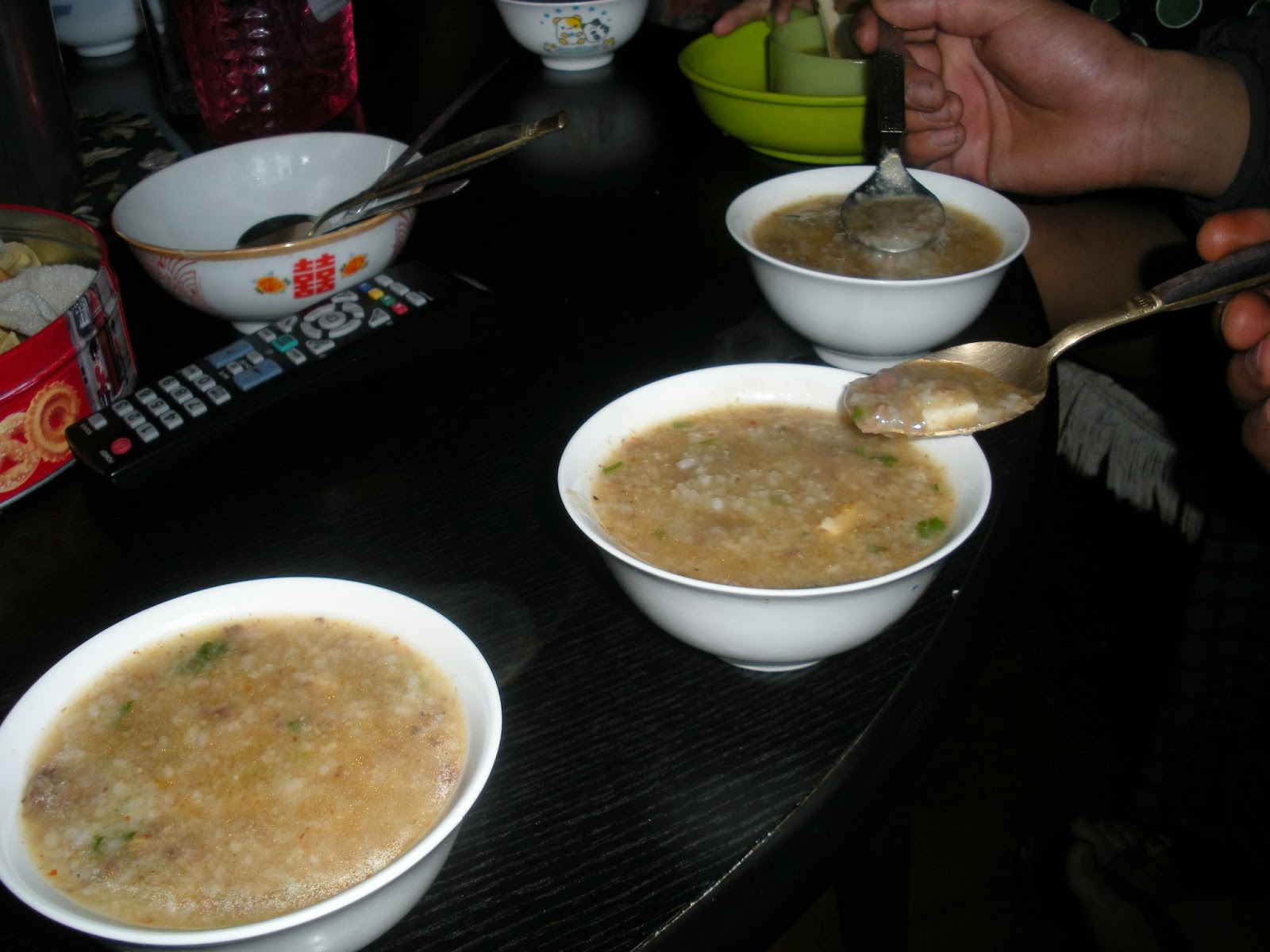
Its also an important family holiday and when I taught in the east of Bhutan, where the holiday is considered particularly important, many of my students made a huge effort to travel home for the day. As it is with many family holidays sharing a meal is an important part of the celebration. Many families will start the day with a bowl or two or three of rice porridge or Thup is particularly important
My sister's inlaws ( who are easterns) invited us to join them for breakfast which of course turned into a regular feast.
As with many visits in Bhutan the meal started off with sweet milk tea and biscuits ....
I ate three bowl full of the rice porridge before realizing that another rice dish, shamdey ( a mixture of rice, butter, meat, eggs and sometimes a little spring onion) was waiting to be served!
This time with a little suja or butter tea....
At the end of the meal my sister's father-in-law insisted that my brother, Sonny, join him in celebrating the day with a glass or ara or home brewed alcohol.
Another reason to raise a glass? This post mark an anniversary for this blog! One year ago one of my very first posts was about Blessed Rain Day and the thub we ate!
Subscribe to:
Posts (Atom)


