Showing posts with label food and ritual. Show all posts

Monday, August 4, 2014

Reading Notes: the Cultural and Social Context of Alcohol in Bhutan

From: Dorji, Lham ( 2012) " Alcohol Use and Abuse in Bhutan"  National Statistics Bureau, Thimphu 

In traditional Bhutanese society, people share drinks when they meet or depart. Alcohol serves as a consolatory treat during bereavement, as part of the relaxed atmosphere and pleasant sensation during festivals, a source of hospitality and as a reconciliatory agent during dispute. Festivals and other  important social events are organized with alcohol as a central enhancement substance.  The traditional offering of tshogchang to official guests as a welcome gesture is an example of the social function of alcohol. It symbolizes respect to the visitor and communal proclivity towards opulent hospitality.  
Alcohol has ritualistic and symbolic functions. It is used to please deities and as a vital substance of various offerings. In certain rituals, monks or lay monks, and nuns use alcohol thought Buddhist vows do not permit them to consume alcohol. In particular, chang used a libation offerings ( gser- skyems, literally 'golden thirst) connotes an elixir to quench thirst. Alcohol is a substantive drink consumed to quench thirsts in farming societies.  This seems to be the reason for drinking being often considered appropriate for those who are involved in manual toil than for those whose task involve mental exertion.  
Alcohol is used to ward off snakes and as protective substances from many evil, and as medicine to cure certain illnesses. Alcohol is a cultural artifact. The volatile, but valuable nature of the fluid has led to the production of a rich material culture like the production and use of chang palang, phob, etc to drink, store and transport alcohol.  
Alcohol is part of child birth observances.  Many mothers even consume alcohol as soon as babies are delivered to relieve pain and regain vigour. In many rural communities, children drinking is not been marked as a social taboo thought things are changing. It is likely that many children growing up in a drinking culture being to form their impressions about alcohol from an early age. This may be one of the reasons for their early acquisition of drinking habits.  

Thursday, February 13, 2014

Reading Notes: Archery and Feasting

From : " The Clear Mirror of Archery in Bhutan" by Chang Dorji, Former People's Representative to the National Assembly of Bhutan ( 2001) KMT Press, Phuentsholing, Bhutan


"Except in times of sickness and death in the village, archery is usually played among friends and acquaintances on festive occasions like the New Year. The most preferred stake among archers is a feast. There are two types of feast. In one case, the winners take only their phorp and toray; in the  the other, butter and cooking oil while losers provide meat and other delicacies. However, both the teams have to supply rice and other provisions. This system is called the tashi gyal or the ' auspicious stake.  Usually the winners have to prepare the feast. 

The following day, another match called the zalog or ' returning the feast' is held. If the winner of the previous day wins the first match played for a score of five, the second match should be played for a total of ten scores, and the third, out of a total of fifteen. If again this is won, losers have to once again host a feast. Another zalog match can be played. The total score this time would be equivalent to the age of the oldest player of the winning team. However , there would be no stake for the feast if the same team  once again loses.  There is a saying that even a woman will eventually win a zalog, because the matches will be played until the loser wins. "

Saturday, September 21, 2013

Happy Blessed Rainy Day

Today is Blessed Rainy Day in Bhutan or Thure, a nationally observed holiday that marks the end of the monsoon (or rainy season) and the beginning of the fall. For farmer ( which according to most statistic would describe most Bhutanese) it means the growing season is behind them and the harvest is not very far away.

On Thure all natural water  is considered holy and everyone is encouraged to take an outdoor bath in order to cleanse themselves of their accumulated bad karma. Some people will leave a bucket out to gather rain overnight and then bathe with it in the morning. 

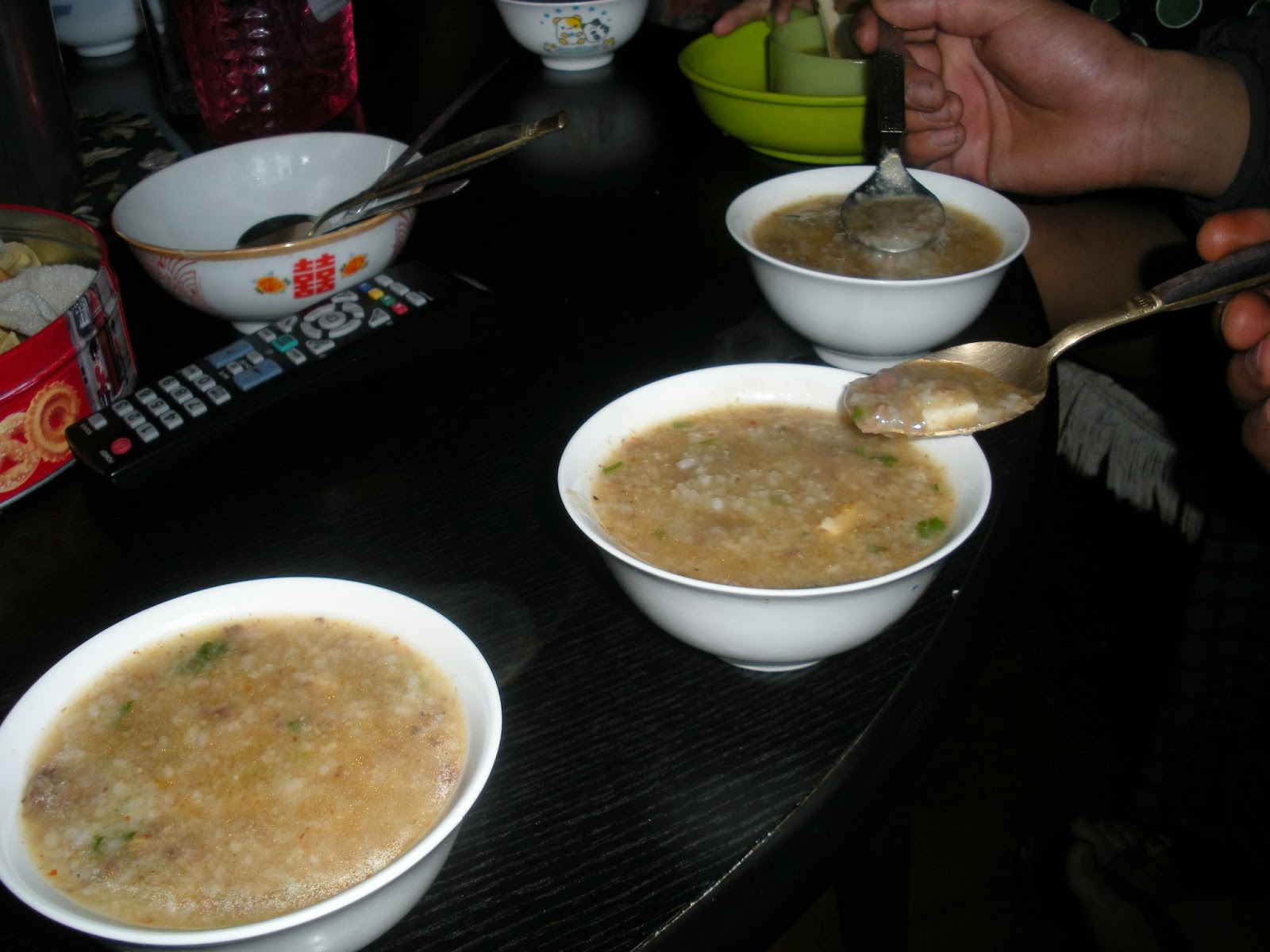
Its also an important family holiday and when I taught in the east of Bhutan, where the holiday is considered particularly important, many of my students made a huge effort to travel home for the day.  As it is with many family holidays sharing a meal is an important part of the celebration. Many families will start the day with a bowl or two or three of rice porridge or Thup is particularly important 

My sister's inlaws ( who are easterns) invited us to join them for  breakfast which of course turned into a regular feast. 

As with many visits in Bhutan  the meal started off with sweet milk tea and biscuits  ....


 quickly followed by steaming bowls of thup...


I ate three bowl full of the rice porridge  before realizing that another rice dish, shamdey ( a mixture of rice, butter, meat, eggs and sometimes a little spring onion) was waiting to be served!


This time with a little suja or butter tea....


At the end of the meal my sister's father-in-law insisted that my brother, Sonny, join him in celebrating the day with a glass or ara or home brewed alcohol. 


Another reason to raise a glass? This post mark an anniversary for this blog! One year ago one of my very first posts was about Blessed Rain Day and the thub we ate!

Saturday, March 30, 2013

Painted cakes


I recently had a birthday. The best part of a birthday in our family is that my sister, Tshomin bakes a cake and then she or her artist boyfriend ( MadHatter) paints the cake. Yes you read that right, they paint the cake! They use an ordinary paint brush and food coloring to produce the most personalized and beautiful cakes. 

For example below is the birthday cheese cake Tshomin made for me last week, decorated with a lady bird and a plastic  panda -- both family nicknames for me. 


The inspiration for making these painted cakes comes from Cake and Empire a blog by a grad school friend of mine who is a talented cake maker as well as an archaeologist. The blog is a wonderful archive of some of the most creative and ambitious cakes she  has made. Amazingly enough her cakes almost always taste as good as they look! 


 Above is my all time favorite painted cake  baked by Tshomin and painted by MadHatter right before I left for my dissertation fieldwork. It depicts me as the Fool in my deck of tarot cards. So let me tell you about the Fool card . The Fool is off on a journey, she has her little pack on her back and she has her head up to the sun in anticipation of adventure. There is a naivete and vulnerable openness that is going to allow her to learn from her experiences. See how she is so busy looking up towards the open sky that she doesn't see the cliff? That both a caution ( watch where you are going fool!) but also an encouragement to take that leap into the unknown. Its hard to imagine a more apt card for the start of fieldwork--- this leap into the unknown, the decision to make yourself vulnerable in order to learn.  A sweet reminder to stay open to all the possibilities (and exciting risks)  that the fieldwork offered.


Monday, November 19, 2012

Time for tea: Suja Desi

We drink a lot of tea in Bhutan. A lot. Its both an everyday beverage and a drink that has an important place on special occasions. If you show up at some one's house, you will be offered a cup of tea. When we have Bhutanese guests for dinner my mother makes sure that we have tea ready for them BEFORE the meal. One of my all time favorite, old time-y customs is bed tea. What an indulgence to be brought your first cup of tea when you are still in bed, only half awake! 


So its perhaps no surprise that tea is also featured in our religious events. Recently my family hosted a blessing ceremony for a new business venture. It was just a small ceremony held on a weekday morning in my parents' living room. At some point during the proceedings tea and desi must be served to the monks who are performing the blessing ceremony.  It was also a great opportunity for me to document the preparation and serving of suja desi or butter tea and savory buttered rice. A combination which is served at all kinds of special and religious events from weddings to blessing ceremonies like this to high level official events.  I think the common element here is lots and lots of butter! Here is the massive block of Bhutanese butter that we chipped away at all morning as we prepared the tea and rice for the ceremony!

Suja or butter tea is a distinctive Himalayan drink.  Its basically made by churning brewed tea with butter and salt. If you are new to it and expecting sweet tea, it can be a bit of a rude shock. The saltiness! The oil!  I always tell people its best to think of it as a soup. And on a cold, cold day there is nothing more wonderful then a steaming hot cup of butter tea.

To make the tea,  loose black tea leaves are mixed with cold water and brought to a boil. A tiny amount of bicarbonate soda is added (to enhance both the taste and color) , then the hot mixture has salt and butter added to it and is churned and churned and churned ( the churn looks a lot like an old fashion butter churn) until its a consistently creamy brown shade . Of course the oil of the butter has a tendency to rise to the top, so with each refill the kettle is gently shaken up to redistribute the butter.


These days we use an electrical mixer rather then a churn and my mother, with an eye on the family's cholesterol in-take sometimes mixes in milk so that she can cut back on amount of  butter we are drinking. However on the day  of the blessing we went all butter !


Desi or the butter rice can be made sweet or savory. The base ingredients are rice, saffron and butter.  Then you can either add chopped green chilli or to make it sweet, raisins, nuts and a little sugar. We went savory. Personally I am not such a fan of sweet desi so I was happy with that choice.


The saffron, butter and chilli are added once the rice is cooked and just mixed in. As you can see we went  ahead and added them to the cooked rice in the rice cooker. That has the additional benefit of keeping the desi warm.


Here is the  suja and desi being served out for the monk who officiated the blessing. My mother even managed to find a fancy tray to serve him on. Of course the best part of the ceremony is when we get our share of suja and desi.


 Its not strictly food related, but I really thought the altar that was set up in the living room with offerings of water, flowers and fruits was rather beautiful. Perhaps you can guess the business venture that the blessing ceremony was conducted for?