Showing posts with label Sonny. Show all posts

Friday, January 3, 2014

More cheese please!

Bhutanese frequently use cheese in their cooking, particularly vegetable dishes. However many households are now more likely to use imported processed Indian cheese to cook with then the traditional Bhutanese datsi. Datshi is made from buttermilk and frequently described as cottage cheese, except a lot of the moisture you expect in cottage cheese is squeezed out as the cheese compressed into palm-sized white balls. Datsi is still available but quality varies widely. We are loath to eat it fresh unless it made by my aunt who still has her own cows and still make her own cheese.  

One quick and easy datshi dish we ONLY make with our aunt cheese, is fried datshi. Its a go-to-dish in our household when a meat-eater unexpectedly shows up for a dinner that is mostly vegetarian.

Recently Sonny and my cousin Bones who is currently living with us, let me photograph the process of making some emergency fried datshi.

The first step is crush the ball of datshi. You can either use a ladle to do the crushing like my cousin Bones or just use your hand like Sonny on the right.


The next step is optional, which is to finely chop some green chili. Bones removed the seeds to bring the heat down a little bit


The you want to melt butter in a deep frying pan to which you first add some beaten eggs. Then you add the broken up cheese.....


... and shortly after that the chopped green chili which gives the mixture a nice pop of green.


The mixture has to be stirred more or less continuously until it becomes a large sticky mass.  To serve you cut pieces off of it much as you would if you were sharing an omelet. 


Saturday, September 21, 2013

Happy Blessed Rainy Day

Today is Blessed Rainy Day in Bhutan or Thure, a nationally observed holiday that marks the end of the monsoon (or rainy season) and the beginning of the fall. For farmer ( which according to most statistic would describe most Bhutanese) it means the growing season is behind them and the harvest is not very far away.

On Thure all natural water  is considered holy and everyone is encouraged to take an outdoor bath in order to cleanse themselves of their accumulated bad karma. Some people will leave a bucket out to gather rain overnight and then bathe with it in the morning. 

Its also an important family holiday and when I taught in the east of Bhutan, where the holiday is considered particularly important, many of my students made a huge effort to travel home for the day.  As it is with many family holidays sharing a meal is an important part of the celebration. Many families will start the day with a bowl or two or three of rice porridge or Thup is particularly important 

My sister's inlaws ( who are easterns) invited us to join them for  breakfast which of course turned into a regular feast. 

As with many visits in Bhutan  the meal started off with sweet milk tea and biscuits  ....


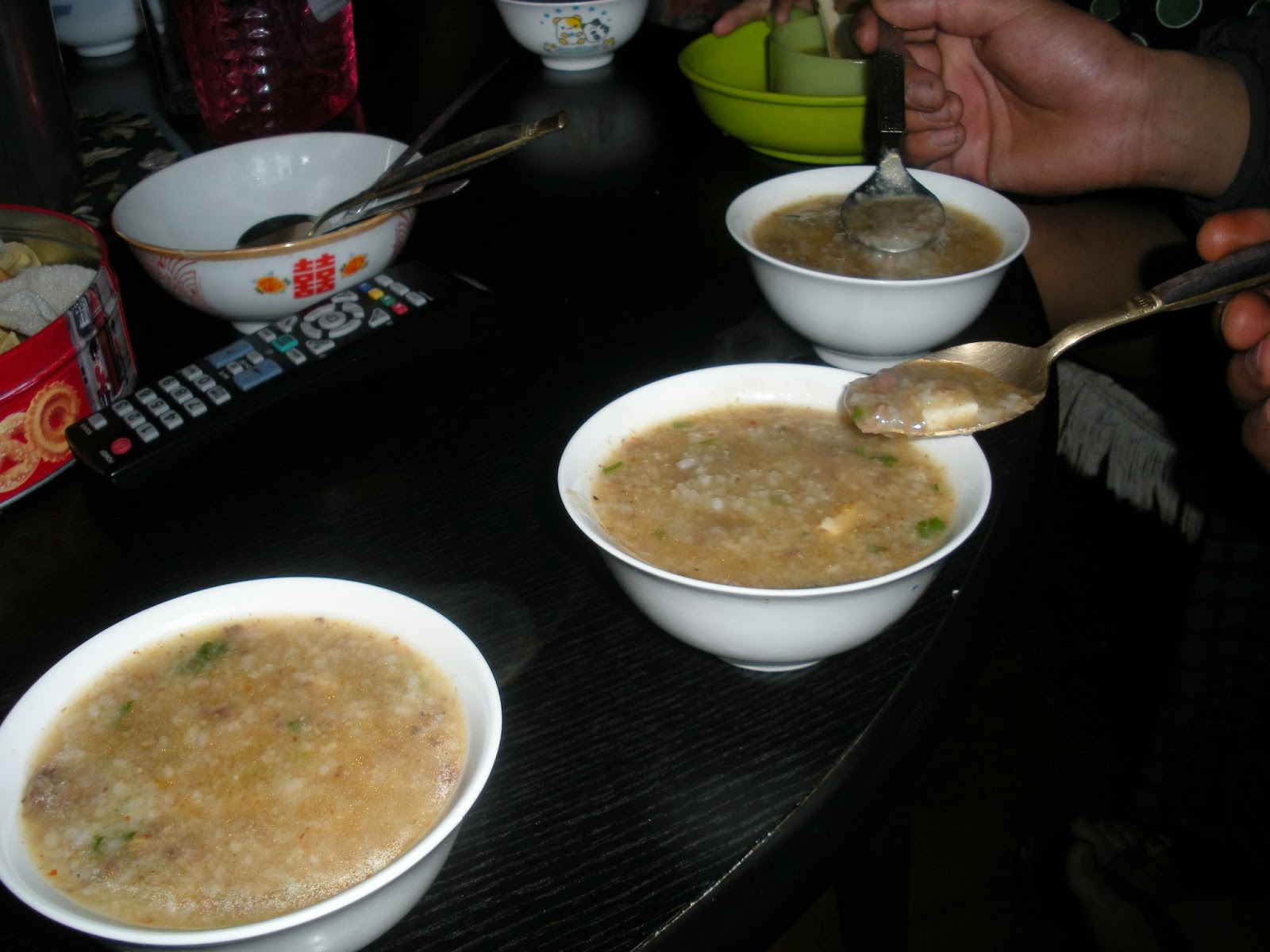
 quickly followed by steaming bowls of thup...


I ate three bowl full of the rice porridge  before realizing that another rice dish, shamdey ( a mixture of rice, butter, meat, eggs and sometimes a little spring onion) was waiting to be served!


This time with a little suja or butter tea....


At the end of the meal my sister's father-in-law insisted that my brother, Sonny, join him in celebrating the day with a glass or ara or home brewed alcohol. 


Another reason to raise a glass? This post mark an anniversary for this blog! One year ago one of my very first posts was about Blessed Rain Day and the thub we ate!

Monday, February 18, 2013

Lunch on a snowy day: Bathup


 Yesterday morning we woke up to a Thimphu covered in a thick white blanket of snow. Unusual not because we don't ever get snow but because usually we see a light snowfall that melts almost as soon as it settles. This time the snow came down so thick and heavy and that is stayed all day into the next one. My facebook and twitter were full of people's photos of the snow including snowmen, snow-women and even one snow-buddha. My mother and my brother, Sonny took the opportunity to make and serve up a typical Bhutanese cold weather meal: Bathup or soup with homemade noodles.

 Below are the assembled ingredients minus the homemade noodles. To left you see a basket of chopped leafy greens (my mother likes to use mustard greens but any other leaf green is likely to work), onions, garlic , ginger and some potato. Potato is not a standard Bathup ingredient but my
mother likes the way it melts in the soup to give it a lovely thick consistency. To the right are salt, chili power, sichuan pepper ( or thingay in Dzongkha) and of course bones.  Bones are critical to making a savory and hearty stock for the noodles. My mother puts everything ,except the greens and  thingay (that goes into the soup absolutely last) into a pressure cooker, adds a tiny bit of vegetable stock powder and lets it all cook until the bones are completely cooked.


In the meantime Sonny prepares the dough to make the noodles. To make the mixture he blends two parts of atta ( or whole wheat flour) with half a part of maida ( or white flour) and warm water.  The mixture of flours gives the noodle a nice texture. Below you can see the kind of consistency
that you need to aim for.


The flour is then rolled out and Sonny used a serrated pizza cutter to slice the dough into noodles. He also used the straight edge of a salad serving soup to make straight and consistently sized noodles.


The cut noodles are kept in a bowl that has flour in it and tossed regularly ( ideally with each addition of newly cut noodles) to keep the noodles from sticking together or clumping.


Once the meat it judged to be cooked, its time to add the chopped mustard greens. These are stirred into the soup and the pressure cooker is now left open and used like a regular cooking pan.


Once the soup comes to a boil again its time to add the homemade noodles. Sonny is careful not to stir too vigorous as this might ruin the noodles. He gently stirs in the noodles, makes sure all of them  are completely submerged in the soup. 


Now its time to add the thingay. My mother has had some thingay sitting on the warm stove as the soup was made  ( not over a lit flame but just sitting out on the stove )  so that they are lightly toasted. Now she crushes them into a coarse powder before adding it to the soup.


As a final touch my mother chops some green onion directly into the soup before serving.


And there you have it, the perfect snowy day meal!


Wednesday, October 3, 2012

How Sonny makes Dal


Dal is pretty much a standard at many of our family meals. It is nutritious ( very high in protein!), tasty and more importantly the fussier members of the household love dal.

Dal is a dish that is eaten all over South Asia, probably a little less in Bhutan than in  other parts of the sub-continent.  It is both ubiquitous and hugely varied. Not only are there lots of different types of lentils that can be made into dal but also a huge number of ways to cook it. In general though  the lentils are cooked long and slow ( or you can cheat a little like with do with an pressure cooker) into a seasoned stew or soup (depending on how thick your family likes it) that is then eaten with rice or  some kind of flat bread like chapati.

Here is how my brother Sonny makes dal on an average weeknight. The lentil we use is orangish in color and based on a quick Internet search is called "split red lentils" or  masoor dal. The first thing we do is wash the dal and soak it water while we prepare some of the other ingredients. The soaking helps it to cook a little faster.


Now Sonny chops up onions, garlic, ginger, tomato and some chilli. You can see on the right hand the approximate sizes to aim for. Later he frys the onions, garlic, ginger and chilli in the pressure cooker. Sonny then adds some salt, curry powder and a bay leaf.


Once things start to get golden ( if they start to  brown you have fired too long!) he adds the tomato and immediately afterward he adds the drained lentils, the drier the better. Then Sonny stirs and let this mixture fry for a while.


Now its  time to add water based on how thick or thin you want the finished product to be ( I am so sorry not to have exact measurements but as discussed in previous posts, Sonny doesn't use measurements when he cooks)


Now its time to seal up the pressure cooker and wait for it to signal with its steamy whistle that the contents are ready ( Sonny let the whistle go three times before he opened up to see how the dal was doing) If you don't have a pressure cooker, you might try soaking the dal a little longer. Pressure cookers are kind of wonderful,  though potentially dangerous for first time users! Read the manual, steam burns are very, very painful!


Once Sonny opens up the pressure cooker he checks for water and salt and adds more as needed.  He then continues to stir until the dal is ready. Just before serving he adds some butter and sometimes chopped coriander ( cilantro for  any American readers) .Once the dal is cooked and served there are still option for how to eat it. Here are two: a)  You can either  pour it over the rice, mix well and eat or  b) you can reserve the dal in a small side bowl and drink it like soup.  Either way Sonny's dal is always delicious!


Friday, September 28, 2012

Dinner by Sonny

My brother, who I am going to call Sonny, is a wonderful cook and more importantly he really loves being in the kitchen. He works professionally in a creative field and once told me that he sees cooking as a extension of being creative. And his cooking is inventive, he doesn't use a cookbook, he doesn't plan his meal in advance or shop with a menu in mind. He usually just takes a look to see what we have in the fridge and pantry and then starts cooking. So below is a typical meal that Sonny might make for the family. 
 
 
He starts by chopping up some beef that he found in the freezer....


an activity that my mother's cat, Kitty clearly finds fascinating.


Once the chopping is complete, Sonny marinates the meat and puts it in the fridge for a while. He refused to tell me what was in the marinade but based on the taste and colors I would guess that mustard and curry powder were featured.


 Sonny fries up some chopped onions, garlic, ginger and tomatoes

 
 Later he will add the meat and some potatoes. 


In the meantime our cousin, PT who is living with our family at the moment, washes the rice and prepares to get it going in the rice cooker.


Here is my brother in the pantry selecting vegetables for a second dish, eggplants and green chilies.


Once the eggplant and chillies are chopped up, he will add some diced onions and salt, some water and let it cook for a while. When things start to bubble he adds butter and two kinds of cheese: first a Swiss style cheese that is made in Bumthang (which everyone calls Bumthang Cheese) and then some datshi or Bhutanese cheese.


 While the eggplant dish is cooking,  Sonny take a moment to sample his beef dish, checking to see that it has everything it needs.


Sonny also prepares two side dishes for the meal; steamed zucchini (from our garden) and a Bhutanese style salad, called hogai with finely diced fresh tomatoes, chilies, onions, datshi and thingnay (sichuan peppers).


What a feast!  Here is a plate of food ready to eat. Dinner is served!