" A curious and macabre cultural feature that deserves mentioning is the poison cult that existed and according to some sources continues to exist in certain parts of Eastern Bhutan and Eastern Monyul. Notorious areas are the Kurma area in Lhuntsi, Upper Tashiyangtse, the border areas inhabited by Dakpa, certain parts of Pemagatshel. Lish and Chuk in Dirang and the Kongpo area and Pemako in Tibet. But practically every area has certain households suspected of poisoning guests. According to popular belief, one should never accept any hot food or alcoholic beverages from household with whom one is not thoroughly familiar. Those suspected of giving poison are always women- most commonly spinsters and widows. They are believed to poison a person in order to obtain his... 'life force.' There are several ways in which the poison is prepared as well as administer. Whereas the usual poison used for hunting is made from Aconitum sp., the poison for the poison cult is home-made. During the new moon, the woman will paint half her face black and half her face white. She will carry an unboiled egg into the forest and whilst uttering secret mantras, she will bury it at the foot of a tree. During the next full moon, she will return to this place and collect the mushroom that usually sprouts from the egg. The mushroom will be dried and ground to a fine powder. The poison can be administered unnoticed, for example by keeping it under the fingernail and adding it to a cup of alcohol when serving it to an unsuspecting victim. The victim has to be, in order of preference, a king, a high lama, a minister, a rich man, a young man, her husband or her son. In absence of any of these she has to consume the poison herself. Death comes slow and sudden, and often poisoning is not suspected. Households thought to be poisoners are usually outcast and stigmatized but at the same time also kept in respect out of fear that retribution might take place. Belief in the poison cult is still strong and in many cases people suffering from sudden and severe illnesses are thought to be /duk rek/ 'touched by poison.' Official policy is to discourage belief in the cult and the social stigma it entails."
Showing posts with label sharing food. Show all posts
Showing posts with label sharing food. Show all posts
Saturday, January 24, 2015
Reading Notes: Rumors of Poison
From: Bodt, Timotheus A ( 2012) " The New Lamp Clarifying the History, Peoples, Language and Tradition of Eastern Bhutan and Eastern Mon" Monpassang Publication: Alblasserdam, the Netherlands

Saturday, September 21, 2013
Happy Blessed Rainy Day

Today is Blessed Rainy Day in Bhutan or Thure, a nationally observed holiday that marks the end of the monsoon (or rainy season) and the beginning of the fall. For farmer ( which according to most statistic would describe most Bhutanese) it means the growing season is behind them and the harvest is not very far away.
On Thure all natural water is considered holy and everyone is encouraged to take an outdoor bath in order to cleanse themselves of their accumulated bad karma. Some people will leave a bucket out to gather rain overnight and then bathe with it in the morning.
Its also an important family holiday and when I taught in the east of Bhutan, where the holiday is considered particularly important, many of my students made a huge effort to travel home for the day. As it is with many family holidays sharing a meal is an important part of the celebration. Many families will start the day with a bowl or two or three of rice porridge or Thup is particularly important
My sister's inlaws ( who are easterns) invited us to join them for breakfast which of course turned into a regular feast.
As with many visits in Bhutan the meal started off with sweet milk tea and biscuits ....


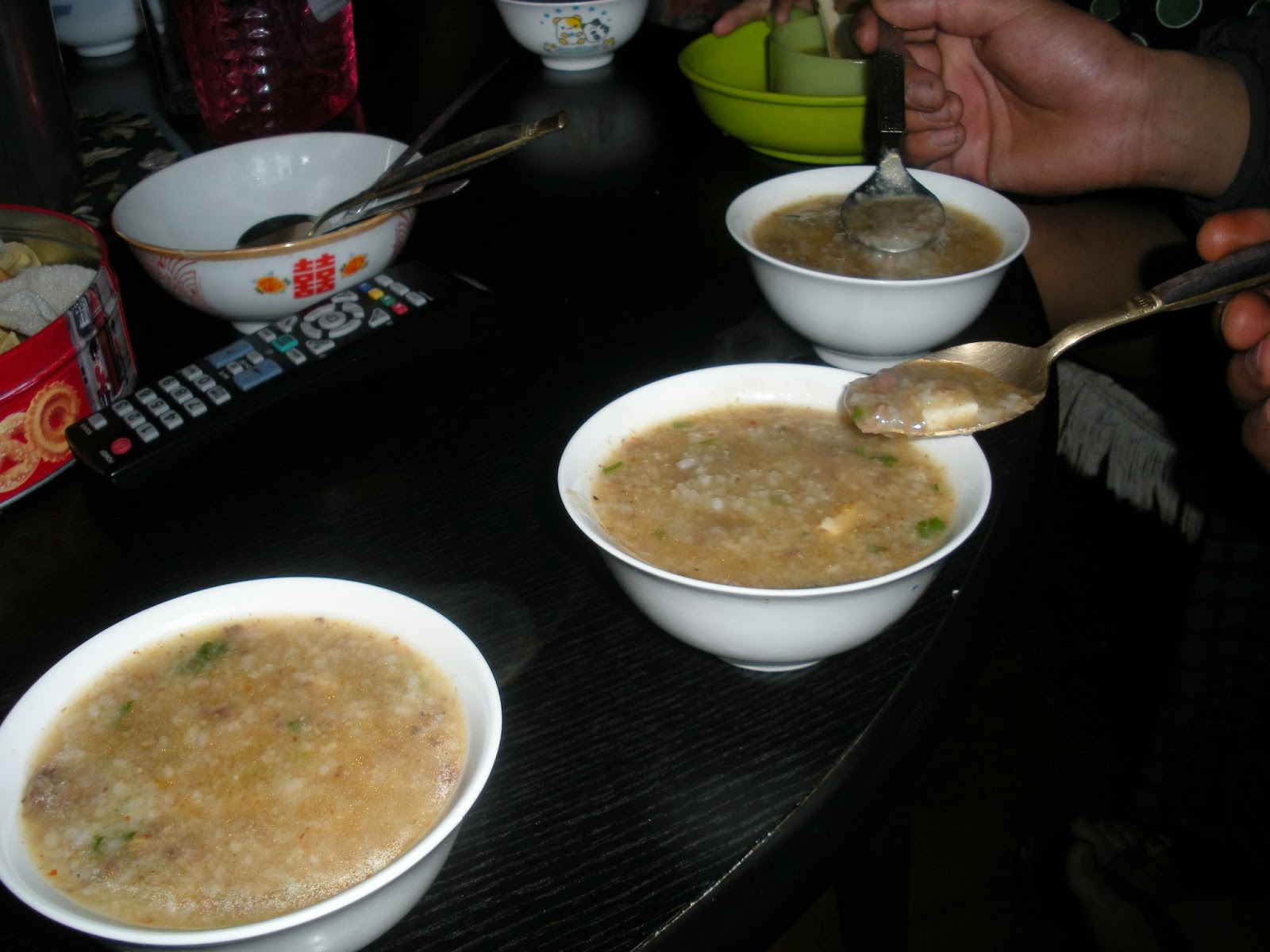
I ate three bowl full of the rice porridge before realizing that another rice dish, shamdey ( a mixture of rice, butter, meat, eggs and sometimes a little spring onion) was waiting to be served!


This time with a little suja or butter tea....

At the end of the meal my sister's father-in-law insisted that my brother, Sonny, join him in celebrating the day with a glass or ara or home brewed alcohol.

Another reason to raise a glass? This post mark an anniversary for this blog! One year ago one of my very first posts was about Blessed Rain Day and the thub we ate!
Sunday, June 16, 2013
Reading Notes: Portraits of grandmothers and their signature dish.

So, the blog Jezebel had a lovely post recently about a photography book focused on grandmothers from 58 different countries posing with their signature home cooked meal. The book was put together by photographer Gabriele Galimberti, the man behind the riveting photo essay of children around the world posing with their most prized possessions. Apparently he was inspired by his own grandmother's ravioli.
Scrolling through a more complete sample of his photos I am struck by how few of the dishes are familiar to me ( I admittedly plan to stay unfamiliar with the Caterpillar in tomato sauce!) However what is perhaps most interesting to me is that glimpse these photos give into the kitchen where these women work their magic.
My Bhutanese grandmother died before we were born but my Swiss grandmother cooked many wonderful meals for us. Our least favorite was probably cow tongue, which was baked whole and looked very much like a cow tongue even as she sliced it up for us.
Monday, April 22, 2013
Reading Notes: Michael Pollen on the Magic of Sharing Food
From Michael Pollen's recent interview with NPR about his new book " Cooked: A Natural History of Transformation"
"Some of the foods that hold themselves out to you as supremely convenient, like those microwavable single-potion entrees in the supermarket? I did an experiment with those. We had what we call " Microwave Night," where we all got to buy one of those, you know, fast-food-in-a-freezer-bag things that they now have in the supermarket. And guess what? It took 40 minuets to get that meal on the table. Because the microwave is individualistic. You can only microwave one person's entree at a time. And you're not sharing. And there's something magical that happens when people eat from the same pot. The family meal is really the nursery of democracy. It's where you learn to share, it's where we learn to argue without offending. It's just too critical to let go, as we're been so blithely doing."
Saturday, April 20, 2013
Reading notes: why we think food = love
I have had a pretty long and trying week and there were a couple moments that only fried food could redeem but the truth is that for me real comfort after a long day is a meal shared with loved ones. Which is why this week I returned to read this great NPR article about how human brains evolved to equate food with love. The articel's inclusion of cute example of bonobos sharing salad makes it well worth the read but what strikes me is the emphasis on shared food as love, even the comfort of the memory of shared food. I completely embrace the idea that comfort food might be a shared meal instead of hurriedly eaten, instantly regretted junk food binge.
Subscribe to:
Posts (Atom)